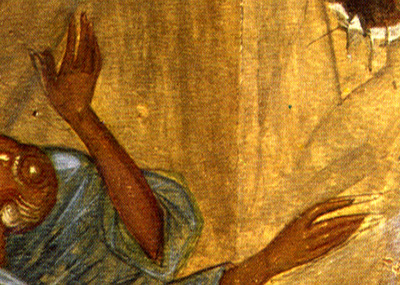
Is it necessary to engrave or not?
"Engraving? That is for beginners! I draw directly on the board!" First of all, this assertion seems inappropriate for an iconographer, and does not correspond to the actual works of the great masters. The picture below – The Transfiguration – clearly shows that Theophanes the Greek not only engraved his drawing, but also () corrected it throughout the painting. We can see on Saint Peter’s top hand the initial engraving of the thumb and its final placing, further right. And on his other hand, how his fingers were shortened.
Engravings are useful when we paint since they enable us to remain accurate with the original drawing. Indispensable for the beginner, engraving is a precious aide for the experienced iconographer, especially when he uses big flat tints. Engraving is less useful when we apply a transparency technique, but there are still many reasons to use it. So, it is up to you.
|
You can engrave all the lines of your drawing, if you want, giving special attention to the face’s and hand’s lines. Don't forget to engrave the inscriptions and the place of the virginity stars so you can later recover them from under the painting. Rub out any traces of pencil, especially in those areas that are later to be covered with a clear and transparent coat of paint, like the inscriptions for example, because the dirt will never disappear completely under the paint.
|