|
|||
Lining the table and the bases The colour of the lines is a mixture of yellow ochre, red ochre and veronese green (a little less than for the house strokes). Use a very fine brush with a good tip to paint the decorations of the bases. The lines must be very solid, so add enough egg to the mixture. |
|||
|
The sides of the bases The front and lateral sides have quite a strong coloring. Make a mixture of red ochre and yellow ochre supported by a touch of burnt umber. Spread a thick puddle without eliminating, however, the effects of transparency... |
||
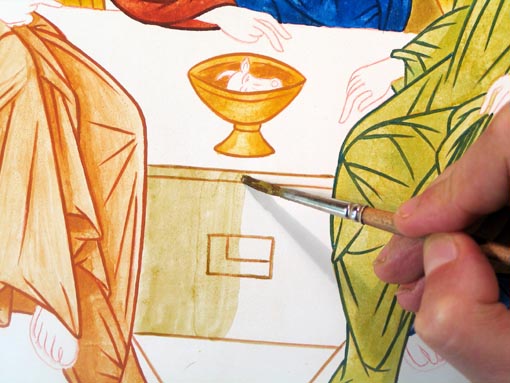
The front side of the table The front side of the table - very damaged on the original - is done in three crossed layers of a mixture of yellow ochre, red ochre and a little bit of veronese green. It is an intermediate technique between the "petit lac" method and glazing. Prepare the mixture as you do for the puddle, with little emulsion and without loading your brush too much. Extend the color moving your brush from top to bottom and from bottom to top, as shown on the illustration, but without stopping until the zone is completely covered. Let dry completely and do it again from right to left and from left to right. This manner to apply pigments produces a very interesting color texture, especially in this case. |
|||
 |
Colouring the top of the bases Prepare a consistent colour of yellow ochre with an addition of chrome yellow. Make a very light puddle pushing the pigments towards the bottom... |
||
 |
Next step: The ground and the down of the feathers |
||
Click on pictures to enlarge... |
|
||
P. Grall © Saint Andrew Workshop 2021 All rights reserved |
|||