 |
 |
|
|
|
Why portable frescoes ?
|
| We have observed an increasing need to decorate a chapel, church, parish room, etc., with a fresco which is not permanent. During 1999, we researched technical solutions in response to this need. We performed several experiments and developed a technique of portable fresco, which allows replacement, removal or change of decoration without all the time and cost of demolition. |
Making a frame
|

- A130 x 50 cm frame for a character in feet. |
The principal qualities of a frame should be its rigidity and good protection of the angles, which are the most fragile points during transport.
Choose L-shaped steel bars of 2 mm thickness for a fresco of 1 m 30 large. The steel thickness will increase proportionally with the format of the fresco but for very large size frescoes it will be necessary to ask the opinion of a metal manufacturer because additional reinforcements could be necessary.
Building a frame with aluminum is strongly discouraged, as it is a metal to which concrete and mortar will not adhere, and the fresco may separate from the frame as it dries.
|
|
|
|
| Here the width of the bends and the depth of the frame is calculated according to the garnishing. |
Weld the elements of the frame by ensuring a perfect squaring. |
|
Covering the frame with lightened concrete.
|
|
Modern construction techniques have developed more lightweight concrete without losing its solidity, such as cellular or aerated concrete, for example. But there is a simple way to make lightweight concrete oneself incorporating very light inexpensive materials that every one can find. Simply purchase small red balls of expanded clay that are used to fill flowerpots. To garnish a small size fresco choose these balls in their smaller size.
It is also possible to incorporate shavings of wood or straw in the concrete, but the weight benefit will be weak and the support may become fragile if these elements are badly distributed.
To cover a frame with concrete it is necessary to use a wire netting. You can purchase this form in a garden center (choose a medium one that is not painted or plasticized). You can also use metal lath which is available from mason supply businesses, however it comes in 30 inch widths, so you will need to make allowances for this in your frame design. Either guarantee a good solidity to the support. It is possible to bore some holes on the circumference of the frame and to place nails that will be covered by the concrete in order to make the unit solid but in general concrete "sticks" well to steel (contrary to aluminum).
|
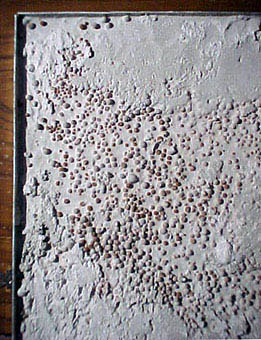 |
- Place the frame on a smooth and level surface and coat it with kitchen oil to allow the removal of the frame once dry.
- Mix five parts of sand (adding some small fine gravel inside) with one part of Portland cement.
- Mix closely with the trowel and add a good proportion of expanded clay balls.
- Wet this dry mixture and work it with the trowel until obtaining a liquid concrete.
- Apply the concrete with the trowel leaving one centimeter height for the following layer.
- If the wire netting rolls up, place stones on it to weight it down. Then when the concrete goes drying, remove these stones and fill the holes with remaining concrete.
- If you put nails all around, check the position of these nails when the concrete starts setting: press them well against the frame.
- Let the concrete dry over three to five days depending on the season. |
|
Covering the frame with cellular concrete.
|
|
The cellular concrete is sold ready to use at building material distributors. It is composed of a lime mixture, cement, aluminum powder and sand to which water is added until obtaining a liquid concrete. While drying, a chemical reaction occurs between lime and aluminum which acts as a gas producing air bubbles that remain captive in the mass.
The advantage of this process is production of lightweight, solid concrete plates. Nevertheless, the use of wire netting is still recommended.
Note : The product in Europe which is called cellular concrete (made with aluminum) is no longer available in the U.S.. The reason is that the government took over strict control of the sale and use of aluminum (or aluminate) because of its use in bombs. As a replacement aerated concrete is now used in the U.S.. It is made by first mixing concrete with water and then injecting a substance with air which creates 70% air bubbles that remain in the concrete indefinitely.
|
|
|
|
|
|


